Why do some cocktails feel inevitable while others feel like a dare? The answer, according to flavor scientists at Foodpairing, is disarmingly simple: ingredients pair well when they share key aromas in common. That principle—combined with the bartender's craft of balancing sweet, sour, bitter, and salty tastes—forms a two-part framework you can use to deconstruct any classic recipe and build new combinations on something sturdier than guesswork.
Beyond Taste: The Dominant Role of Aroma in Flavor
Here is the counterintuitive starting point: most of what you call "taste" isn't taste at all. Foodpairing's analysis of ingredient pairing puts it plainly—roughly 80% of our flavor experience is defined by our sense of smell. When we say something tastes good, what we usually mean is that it smells good, because volatile aromatic compounds reach the olfactory receptors and color everything we perceive on the tongue.
The tongue itself only registers the basic tastes. Foodpairing counts five of them: sweet, salty, bitter, sour, and umami. These are real and essential, but they are the scaffolding of a drink rather than its personality. Aroma supplies the citrus brightness, the herbaceous green note, the juniper sharpness—the details that make a gin and tonic taste like gin and not like sweetened water.
Trilogy Flavors, a flavor-creation company, describes every memorable food and beverage as an interplay of taste, aroma, and texture, insisting that pairing is as much art as science. For our purposes, the science comes first: if aroma dominates perception, then aromatic overlap between ingredients is the primary engine of harmony in the glass.
The Science of Shared Aromatics: Why Ingredients 'Click'
The core principle is that ingredients seem to have a "natural affinity" for one another because they genuinely do—at the molecular level. Foodpairing's methodology is built on identifying the volatile aromatic compounds in each ingredient and matching ingredients whose aromatic profiles overlap. Gas chromatography–mass spectrometry (GC-MS) is the laboratory technique that makes this possible: it separates and identifies the individual volatile compounds that rise off an ingredient into the nose.
This is what separates a principled pairing from a lucky one. Two ingredients that share dominant aromatic compounds will read as harmonious even when their tastes differ sharply, because the nose finds familiar ground between them. Conversely, ingredients with no aromatic overlap can sit side by side in a glass and never quite merge, no matter how carefully you measure.
An important caveat keeps this honest: as Bols Cockcuts' editorial team puts it in their pairing guidance, a tool that flags chemical compatibility does not guarantee cocktail balance. Compatibility tells you two ingredients can coexist; it does not tell you the result will be pleasant to drink. That gap is exactly what taste balancing fills.
A Tangible Link: Gin, Lime, and Basil's Shared Aromas
The abstraction becomes concrete in one of mixology's favorite trios. Analytical studies of gin's aroma—work drawing on GC-MS and GC-olfactometry—repeatedly identify terpenes including limonene, α-pinene, β-pinene, myrcene, linalool, citral, and geraniol. A 2020 gin study found the detected odorants dominated by mono- and sesquiterpene hydrocarbons, with α-pinene and β-pinene among the monoterpenes typical of juniper berry extract.
Citrus brings the same family. GC-MS analyses of citron peel—the fragrant citrus closest in character to lime—identify limonene and citral as the main aromatic substances in both peel and leaves. Basil, meanwhile, is no stranger to the club: a GC/EIMS analysis of basil essential oil identified volatile components including dl-limonene, L-linalool, α-pinene, and β-pinene.
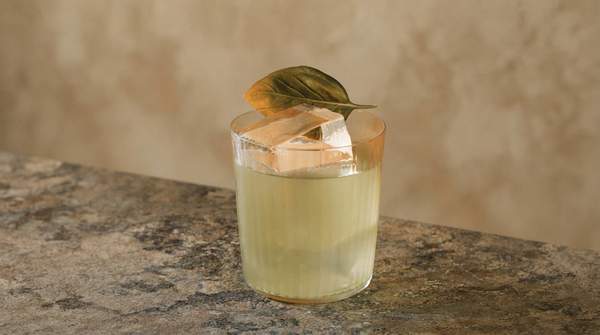
Read those lists side by side and the affinity between gin, lime, and basil stops looking like folklore. Limonene, linalool, and the pines appear across all three. That is the representative science behind a basil gin sour; it is not a complete inventory—other compounds contribute to each ingredient's profile—but it shows the principle working in ingredients you can buy tonight.
The Two-Dimensional Flavor Pairing Framework
Everything above compresses into a working diagnostic method. Use it to take a recipe apart, or to assemble a new one:
| Step | Question | What the evidence supports | Outcome |
|---|---|---|---|
| Step 1: Aromatic compatibility | Do these ingredients share key aromatic compounds? | Pairings succeed when ingredients "share key aromas in common"—e.g., limonene, linalool, and pinene linking gin, lime, and basil. | A scientific reason the combination reads as harmonious rather than clashing. |
| Step 2: Taste profile balance | Are the basic tastes adjusted so the drink is palatable? | Sweetness adds richness and balances sour or bitter; sourness provides refreshing sharpness, typically from citrus. | A finished, drinkable cocktail rather than an aromatically coherent but unbalanced experiment. |
The two dimensions answer different questions. Step 1, drawn from Foodpairing's aromatic-matching methodology, explains why two ingredients can sing together. Step 2, the sweet-sour-bitter logic bartenders apply afterward—as Monin's flavor-pairing guide puts it, understanding each profile's role is crucial before experimenting—determines whether the result is pleasant to drink. Aromatic compatibility is the foundation; taste balance is the refinement.
Framework Step 1: Identifying Aromatic Compatibility
In practice, you rarely need your own mass spectrometer. Ingredient families already track aromatic chemistry. Citrus peels lean on limonene and citral; piney herbs and juniper share pinene; many soft herbs carry linalool. When you taste a promising combination—say, tarragon with grapefruit—ask which aromatic family both belong to, and whether that family appears elsewhere in the drink.
Pairing tools and charts can surface partners you would not try on instinct, as Bols' editorial team notes, flagging chemical compatibility you might miss. Treat those suggestions as exploration, not instruction: they identify candidates, and they can pair herbs with fruits or spirits in ways that surprise. Your palate still decides.
Framework Step 2: Balancing Basic Taste Profiles
Once the aromatic ground is shared, tune the tongue's channels. Monin's guide assigns each basic taste a job: sweet adds richness and body, softening potent ingredients and balancing sour or bitter; sour provides refreshing sharpness, typically from citrus or fermented ingredients; bitter and salty (or umami) supply edge and depth. The "perfect balance and proportion of ingredients," as the mixology writers at Barmalade describe it, is the hallmark of the skilled mixologist.
The classic pattern is a triangle: a strong aromatic base (gin), a sour citrus modifier (lime), and a sweetener calibrated against them. Once the aromatics cohere, the sweet-sour-bitter adjustments are where your own recipe lives—too much sourness and the shared aromas never land; too much sweetness and the drink flattens into them.
Crafting Your Next Harmonious Cocktail
Apply the two-step framework—aromatic compatibility followed by taste balance—to create innovative and harmonious cocktail pairings. Start with one ingredient you love, ask which aromatic compounds define it, find partners that share those compounds, and only then adjust sweet, sour, and bitter until the glass feels complete.
The measurable indicator of success is a noticeable improvement in the complexity and balance of your self-created or modified recipes, evidenced by positive sensory feedback—the moment when a drink you built from shared aromatics, rather than copied from a list, tastes deliberate. That is the difference between following mixology and understanding it.
Sources
- The Science behind great ingredient pairings - Foodpairing
- The Science of Flavor Pairing: Why Some Combinations Just Work — Trilogy Flavors
- Flavor Pairing Chart: How to Build Balanced Cocktails — Bols Cocktails
- MDPI
- Weinobst
- IOCV
- Application of GC/EIMS in Combination with Semi-Empirical Calculations for Identification and Investigation… — SCIRP
- How to Pair Flavors - Monin US
- The Science Behind Mixology: Understanding Flavors and Combinations - Barmalade