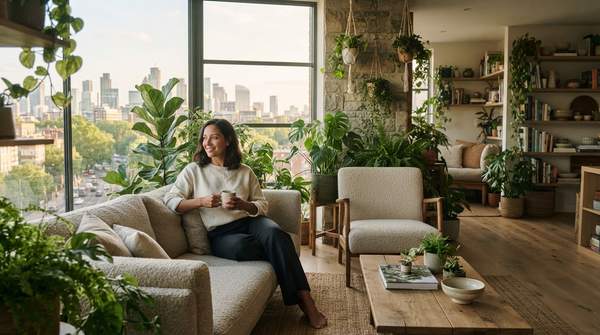
Biophilic design is the practice of connecting people with nature through architecture and interior design, and it is unusually well suited to the constraints of a small city apartment. Interior design writers focused on compact urban living describe it as a way to reconnect city dwellers with the natural world even in condensed spaces, with reported benefits including reduced stress, improved mood, better air quality, and enhanced creativity. The good news for renters is that the most impactful interventions—light, plants, natural materials, and sensory detail—require no structural changes, no landlord approval, and often very little money.
Why Biophilic Design Matters for City Living: Benefits for Well-being
The case for biophilic design rests on a simple tension: urban living concentrates people away from the natural environments they respond to. Terrapin Bright Green, whose "14 Patterns of Biophilic Design" framework helped codify the field, notes that humanity has become urban, with a projected 70 percent of the world's population expected to live in cities in coming decades—and argues that reconnecting people to an experience of nature through design is "not a luxury, it's a necessity for our health and well-being."
The reported benefits map directly onto common city stressors. Writing on biophilic elements in the built environment, Shepley Bulfinch cites research indicating that natural lighting, greenery, and organic textures have been shown to reduce stress, enhance cognitive function, and promote overall well-being. The Journal of Biophilic Design summarizes findings from environmental psychology and neuroscience suggesting that exposure to nature improves attention, memory, and mood while reducing stress and fatigue. Guides aimed specifically at compact apartments add practical outcomes: improved mental health, enhanced cognitive function and creativity, better air quality and humidity from plants, and improved sleep patterns. These are reported psychological and well-being effects drawn from studies and observations—not medical claims—so treat them as design goals rather than treatments.
Core Principles: The 14 Patterns of Biophilic Design for Apartments
The most widely used organizing framework comes from Terrapin Bright Green, which groups biophilic patterns into three broad categories. The first, nature in the space, covers direct natural elements: light, plants, water, and natural airflow. The second, natural analogues, covers materials, colors, and forms that evoke nature—wood, stone, biomorphic shapes and patterns. The third, nature of the space, addresses spatial experience itself, most famously the balance of prospect (open views) and refuge (a sense of enclosure and safety).
These categories were developed for buildings at large, but they translate cleanly to a rental apartment. You cannot add a green roof or move windows, but you can control what sits inside them: how light enters, what textures surround you, and where the room offers both an open sightline and a cozy corner. The framework's value for an apartment dweller is diagnostic—it tells you which dimension of "nature" is missing from your space, and therefore which intervention will fill the gap most efficiently.
Practical Strategies: Bringing Nature into Your Apartment
Start with the "nature in the space" category, where the evidence is most direct. Maximizing natural light is fundamental to biophilic design, and its effectiveness depends on your apartment's orientation and existing light sources—so begin by observing how daylight actually moves through your rooms. Sheer curtains rather than heavy drapes let you keep privacy while preserving diffuse light; mirrors placed opposite windows can carry daylight deeper into a narrow floor plan.
Plants are the second pillar. For small apartments, vertical gardens are a practical solution: growing plants on walls maximizes greenery without sacrificing floor space, and low-maintenance varieties like ferns and pothos suit renters who want a lush look without demanding care. Beyond aesthetics, indoor plants are credited with improving air quality by absorbing toxins and releasing oxygen, and with increasing humidity—benefits that matter in sealed, climate-controlled city buildings. Water is the third element: a small tabletop water feature introduces non-rhythmic sensory stimuli that many people find calming, though its impact is primarily sensory and varies by individual preference.
Practical Strategies: Natural Analogues and Spatial Design
The second category works by evocation rather than direct contact. Using natural materials like wood and stone in furniture, shelving, or decor can promote comfort and calm—an effect based on perceived connection to nature rather than direct natural interaction, but no less real for that. Biomorphic forms and patterns—leaf motifs, organic curves, fractal-like prints—contribute a sense of order and aesthetic appeal that designers link to reduced stress.
Spatial strategies round out the framework. The prospect-and-refuge pattern asks for both an open view and a sense of enclosure; in a studio or one-bedroom, that means arranging a reading chair to face the room's longest sightline while backing it against a wall or tucking it behind a shelf. Shepley Bulfinch highlights the value of a central focal point offering "reflection, stillness" and cites studies on integrating multiple sensory experiences—so consider a small wind chime near a window, or a scent source like dried lavender, to engage more than just the visual sense. These moves cost little and require no structural change, which is precisely why they suit renters with limited space and budgets.
Your Biophilic Apartment Checklist: A Self-Assessment for Urban Dwellers
Use the framework below to diagnose your own space. For each row, check whether the application already exists in your apartment; unchecked rows become your personalized project list, organized by principle so you can prioritize by effort and impact.
| Principle category | Specific application | Reported well-being benefit | Practical examples |
|---|---|---|---|
| Nature in the space | Dynamic and diffuse light | Enhanced mood and productivity | Sheer curtains; mirrors opposite windows; observe daylight patterns first (effectiveness depends on orientation) |
| Nature in the space | Greenery and vertical gardens | Improved air quality, humidity, and calm | Wall-mounted planters with ferns or pothos; low-maintenance potted plants |
| Nature in the space | Presence of water | Non-rhythmic sensory stimuli that can reduce stress | Small tabletop water feature (impact is sensory and varies by preference) |
| Natural analogues | Material connection with nature | Comfort and calm through perceived connection | Wood shelving, stone coasters, natural-fiber textiles |
| Natural analogues | Biomorphic forms and patterns | Aesthetic appeal and a sense of order | Leaf motifs, organic curves, nature-inspired prints |
| Nature of the space | Prospect and refuge | Comfort and a sense of security | A chair facing the longest sightline, backed by a wall or shelf; a defined cozy corner |
| Nature of the space | Multi-sensory focal point | Psychological restoration and stillness | Wind chimes by a window; a scent element such as dried lavender |
Read the table as a gap analysis: each unchecked cell is a candidate project, and the cheapest, highest-impact starting points are usually light treatment and plants, since both carry direct well-being associations and suit small footprints. The psychological rows—materials, patterns, spatial arrangement—cost least of all and layer naturally onto purchases you would make anyway.
Transform Your Urban Apartment: A Step Towards Enhanced Well-being
The decision is simple and low-risk: implement at least one biophilic design intervention from each of the "Nature in the Space" and "Natural Analogues" categories within the next month. That might mean a sheer curtain swap and a pothos on a wall shelf, plus a wooden side table and a nature-patterned textile. The measurable indicator is to observe a noticeable improvement in mood, reduced stress levels, or increased comfort within your living space. Because the reported benefits are drawn from studies and observations rather than guaranteed outcomes, treat the first month as your own experiment: pick the interventions, note how the room feels before and after, and let that observation guide which principle you invest in next.
Sources
- Embrace Biophilic Design in Your Compact City Apartment – DIG Interior Design Solutions — DIG Interiordesign
- Incorporating Biophilic Design into Urban Apartments — Home World Design
- 14 Patterns of Biophilic Design — Terrapinbrightgreen
- Six Principles of Biophilic Design - Biophilic Design Elements — Shepley Bulfinch
- What is Biophilic Design — Journal of Biophilic Design
- Rentcafe